Saturday, August 12, 2017

August (second week) 2017 Reads

This week we started Two Month Review #2.1: Introduction to Tómas Jónsson, Bestseller
This Icelandic novel promises to be a challenging (and rewarding) book. I will try to resist the temptation to read too far ahead.

The first read is a short one (pp 1-31) and the podcast is an informative one with the translator, Lytton Smith, as Chad's guest.

Last week I fell behind on my  “Deal Me In 2017!” short story challenge so I have two this week.

Last week's Story: The Facts Concerning the Recent Carnival of Crime in Connecticut by Mark Twain (on my Kindle)
A clever story about a man who comes face to face with his conscious, there is a verbal duel, the man wins, society loses.

Card: The Ace of  Clubs from the Game of Authors. 


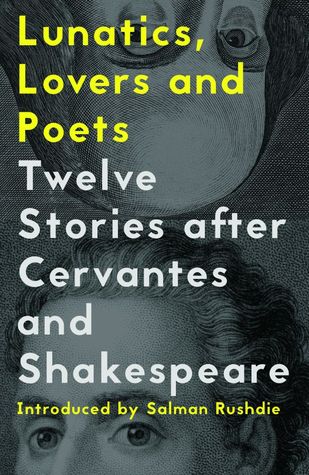
This week's Story: Egyptian Puppet by Vicente Molina Foix, translated by Frank Wynne (in Lunatics, Lovers and Poets: Twelve Stories after Cervantes and Shakespeare, edited by Daniel Hahn and Margarita Valencia; introduction by Salman Rushdie)
This anthology was put together to commemorate the 400th anniversary of the deaths of Shakespeare and Cervantes. Six English speaking authors were asked to contribute original stories inspired by Cervantes. Six Spanish language authors contributed stories inspired by Shakespeare.

This story was inspired as much by Shakespeare's times as much as by his works. It is not a retelling of any work, it is a telling of what life might have been like for one of the theater goers who attended one of the plays. Margaret attends a performance Antony and Cleopatra with her husband, a prison guard. The next day the husband disappears and this is the story of Margaret after that. It involves a meeting with a performer and a look backstage at the Globe.

As with all such projects, the quality and appeal of the stories vary. I suspect that I didn't start with the best although I appreciate the approach the author took with it. I look forward to reading the other stories.  The other authors are Ben Okri,  Kamila Shamsie, Juan Gabriel Vasquez, Yuri Herrera, Nell Leyshon,  Marcos Giralt Torrente, Hisham Matar, Soledad Puértolas, Deborah Levy, Rhidian Brook, and Valeria Luiselli.

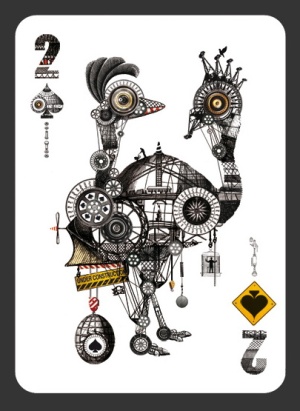
The card was the Two of Spades: According to Rushdie in the introduction "We don't know if they [Shakespeare and Cervantes] were aware of each other...."
Perhaps they will meet in some future or alternate world and will be joined at the hip and collaborate on some wondrous, Spanglish, steampunk classic.

The card, appropriately, is from a sort of art anthology--the Collective Art Project (CAP) Deck: 52 Aces Playing Cards by Zeixs [2nd Edition] The 2♠ is by Argentine artist  Diego Hernan Mazzeo


And while I am on the subject of anthologies, here is an ambitious project: the Global Anthology "an initiative that highlights a work of prose from every country on Earth, as well as many nations, states, sovereignties, territories, and flag-less regions."  These are links to material in various online publications. Each piece is written in or translated into English and each writer is native to the country represented. Worth exploring.


And I finished this from my shelves...

Nowhere People by Paulo Scott, translated from the Portuguese by Daniel Hahn
Not much to say about this fine novel. The info on Goodreads says it all. 

Saturday, August 05, 2017

Six Degrees: Austin to Thiebaud and back again

For the 6 Degrees of Separation Meme

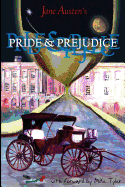
 https://www0.alibris-static.com/isbn/9781599377018.gifSo we start with Pride & Prejudice, a book I had to read in high school. I hated it then and don't especially like it now, although I've grown up enough to appreciate its importance in literary history.

(Cover is from the 1950 Signet edition--which may or may not be the one we read in the late 50s)

Austin just isn't my cuppa, but it takes me to another high school required reading which I did like...


...Les Miserables. I loved the book. Later I saw the musical when I was in grad school. I had a really cheap student ticket. My seat was in the back row of the balcony with little leg room. I was scrunched between two really tall gentlemen who had to sit spread legged thus considerably invading my space. We all tried to be nice--they actually stood up during much of the show. I stood through one long musical number so they could sit. There was much joking about how our situation gave a whole new dimension to the title of the play.
(None of the covers from the 50s fit any edition we'd have read in school so I went with this image from  Amazon. It's a playbill and ticket--probably a better seat than I had--for the show I attended in Boston 1988.)

And that little story leads me to a book I read in another cramped circumstance...

...The Octopus: A Story of California written by Frank Norris in 1901. I am currently reading this on my Kindle so I decided to read it in the car while waiting for someone who was having a long appointment. This was just a few days ago. I have often read in the car with no problem but I have a new car. I love my car but a compact is no match for a standard sedan for getting comfortable with a good ebook and this book is just not that good. It's all about farmers vs railroads in the early days of rail transport in the San Joaquin Valley. A classic California novel which, for me, hasn't stood the test of time.
(Boring cover 'cause it's a Kindle freebee)

This leads to a classic set in the same region which has stood the time test...


...The Grapes of Wrath another California classic (from 1939) which is also set in the San Joaquin Valley. I've read this a ton of times. When the book first came out many farming communities banned the book from schools and libraries. By the time I was old enough to read it the ban was pretty much gone. In 2002 it was chosen for the California statewide reading program.
(This is the cover from the first edition, which my parents had and hid because they lived in rural California. It's my favorite of all the covers for the book.)


And, staying in the valley, with still another California classic with a great cover...


...My Name is Aram, a 1940) book of linked short stories by William Saroyan about an Armenian immigrant family in Fresno. I read this during the summer between grade school and junior high.
 (Love these original covers!)


This leads me another California classic I read in the summer (different summer)...

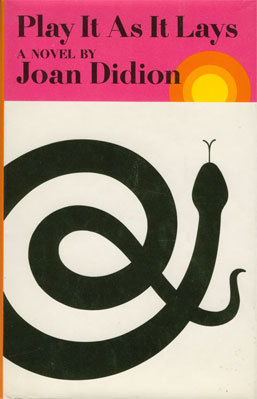
 ...Joan Didion's Play It As It Lays (cover for first edition, which is the edition I read). This one is set further south and more recent (1970)
When I think of this book I vividly remember the character Maria Weyth aimlessly driving the freeways.


Those freeways lead me back north to Sacramento (Didion's and my hometown) for a step into the art world and an artist who was getting noticed in his field at the same time Didion was getting noticed in her field...


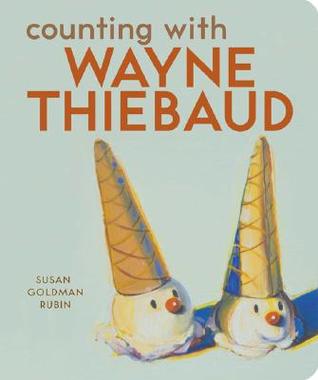
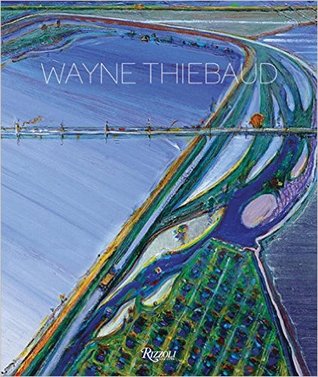
Wayne Thiebaud was painting cakes and ice <--cream cones when Didion wrote Play it as it Lays, but he later moved on to landscapes often featuring freeways.-->

   And all of this can circle back to---        
        ---Pride & Prejudice---

                    How???


Because while I was reading P&P at Didion's alma mater,  Didion was beginning her career at Vogue and Thiebaud was teaching at the college which was to become one of my alma maters. Although I knew some of her family I've never met Didion. I did know Thiebaud (but not well) back in the day.

Saturday, July 29, 2017

August (first week) 2017 Reads

My blog is really lagging this week. I haven't read my story of the week, haven't made any notes on my reading, and haven't searched for a card. Will try to do something with some of this during the week. No excuse for the blog blahs, it just happens sometimes.

Story: The Facts Concerning the Recent Carnival of Crime in Connecticut by Mark Twain (on my Kindle)
Card: Ace of  Clubs- this should be an interesting search for an image. 

online...
More stuff  at Three Percent concerning the Two Month Review: a lively podcast featuring  Rodrigo Fresán, author The Invented Part, and a fun written-to-formula jacket blurb by Chad Post. 

Literature as Life: Sergio Pitol’s “Trilogy of Memory”  by Ignacio M. Sánchez Prado
Goodarticle about one of my favorite authors.

Sheesha Ghat by Naiyer Masur; Translated from the Urdu by Moazzam Sheikh and Elizabeth Bell
Short story

The Bones of Louella Brown by Ann Petry from her story collection, Miss Muriel and Other Stories.
A mix-up in a mortuary is more than embarrassing for the undertakers and a prominent family.

from the library...  
Reading Writing by Julien Gracq, translated from the French by Jeanine Herman

The Best Minds of My Generation: A Literary History of the Beats
by Allen Ginsberg, Bill Morgan (Editor), Anne Waldman (Introduction)

July (fourth week) 2017 Reads

We finished it!

The Invented Part by Rodrigo Fresán, Translated from the Spanish by Will Vanderhyden
This has been an amazing experience. Chad Post of Open Letter Books has led the Two Month slow read of this fantastic novel by providing summaries of each section, broadcasting weekly podcast discussions, setting up a Goodreads group, and publishing a Will Vanderhyden interview with Fresán.

This book was so complex, so convoluted, so full of surprises, so much fun that I can't possibly do it justice here. The best thing is to defer to Chad's great material at the Three Percent blog.

I love this book. It's one of the best things I've read this year. I and look forward to more Fresán.


“Deal Me In 2017!” Story of the week: Joy of Traveling by Jung Young Moon (in A most ambiguous Sunday, and other stories), Translated from the Korean by Jung Yewon
Two men and a woman have agreed to go on a trip together, but one of the men, K, doesn't show up. The others decide to go anyway.
As they drive they have a disjointed inconsequential conversation, make a couple of stops, he takes some pictures.
The narration fills in with how the two met and how they met K, a bisexual. It's not quite clear what the relationships are, we can only guess...

Card: Seven of Spades from Zoe's blog thing:  Engineering! Art! Stuff!
Zoe and another artist started modifying a deck of cards with various designs. They seemed not to have finished the project (the blog hasn't been updated recently). The few displayed are quite fanciful and some are in full color. It looks like a fun project.

This card might describe the countryside the couple (their names aren't given) in the story are driving through. There are rolling hills with vineyards and a rice paddy.


online...

Sequoia Nagamatsu - Stories
The author of the story collection Where We Go When All We Were Is Gone provides links to online publications of his stories. I'm slowly making my way through these links. Some lead to free, full text stories, other stories are available by purchasing online issues. I really enjoyed the ones I could freely access. In some cases I had to use a site's search function to find the story because it had gone to archive. But even if you can't find Nagamatsu's work these links lead to some interesting journals.

Translator as Medium by Charlotte Mandell

What Fourth-Grade Archaeologists Have Found in Their School’s Closet by Eric Grundhauser

The Ghost Villages of Newfoundland: A controversial government resettlement program has left centuries-old fishing villages abandoned by Luke Spencer
  A good novel about a holdout of the relocation is  Sweetland by Michael Crummey.

In Defense of the Emoji Building and Architecture Being Fun, Sometimes by Rory Stott
The arguments against seem to center around that these are frivolous, that they will go out of date, or that they are sending us down a slippery slope.
Maybe architects have to think that architecture must be serious, timeless, etc., but I come in on the side of being a little playful now and then. I like a building that makes me smile.
Dated? Let's get rid of gargoyles, coats of arms, art deco scrolls and flourishes, or anything else that suggests when a structure was built. Boring.
Slippery slope? What next? Does this open the door for medallions featuring @, #, recycling symbols, and other graphic signs of our times? So what? Shrug.

from my shelves...

https://images.gr-assets.com/books/1354209825l/436055.jpgLunar Follies  by
It's not quite accurate to say I've finished this book. I have read all fifty-three items, but I've only read them once. Like poetry, this is the sort of thing -if one likes this sort of thing- to reread. It is, so to speak, a parody of parody. A spoof on almost everything: art, sports, personal names, critics and criticism, writing, itself, four-letter words, and (I suspect) readers of books like this.

It seems oddly appropriate that I got this book in a ten dollar blind grab-bag purchase from the publisher. I also liked the other books in the bag, but this one was the most fun.


from the library....

Lincoln in the Bardo by George Saunders (Kindle edition)
Somewhat innovative way to tell a story, too bad there wasn't much of a story. Lost souls wandering in the 'Bardo" of a Georgetown Cemetery, trying to pretend they aren't dead, try to convince the newly arrived Willie Lincoln that he should immediately move on to a better place. Gimmickry, maudlin--a graphic novel without any pictures. It's listed as having 368 pages, but there is a lot of white space so it didn't take me long to read it.

Blacklands (Exmoor Trilogy #1) by Belinda Bauer
Stand alone mystery/suspense. Young boy seeks answers to a long ago crime. Although the protagonist is eleven years old, this is not a kids book. Bauer's more recent Rubbernecker is a much better book so I won't give up on this author. But I won't be reading Parts 2 & 3 of this trilogy.

Wednesday, July 26, 2017

What Else I Read Whilst Reading "The Invented Part"

Wednesday afternoon (July 26. 2007) I caught the tail end of Chad Post et al on WXXI's Connections There was a discussion on what to read after you've read a terrific book like The Invented Part. Does it spoil you for anything - everything - else? Not for me, but maybe it's time to reread Tristram Shandy. Or maybe I should finally read some Proust or Joyce. Or that Icelandic thing Chad keeps mentioning. Or binge watch Twin Peaks. Or listen to the Kinks. Or just go sit on the dock of the Bay.

When we started the two month read I wondered what I would whilst reading the book, I didn't even think about after. I always read more than one book at a time and I decided I'd just go on as usual. Since I read about sixteen books a month (love retirement) I figured I would probably read around thirty other books during the slow read. I actually read about twenty-three. I also read my usual of amount of online short stories, articles, etc.

Did my reading of the Fresán book influence my other reading? In some cases yes, others not so much. And did my other reading influence my reading of the Fresán book? Maybe, maybe not. I think I'll go back and unread all those books and see if it makes a difference.

So here a list of what I read, with a few notes that may or may not address these questions.

most of these are covered elsewhere on the blog but I wanted to view them altogether
* indicates translated work
RF = Ricardo Fresán
TIP = The Invented Part
Date is date I finished the book, I was usually reading two or three concurrently.

*The Magician of Vienna; Pitol, Sergio: Jun 5
 I think my enjoyment of Pitol's adoration of Chekhov was enhanced because I was reading RF--or maybe I my enjoyment of RF's comments on Chekhov was enhanced because I was reading Pitol.
   I had already started this before starting TIP. This was a slow (2 week) read for me, but I was much slower with the first two volumes of Pitol's "Trilogy of Memory"- Spent 11 months with The Art of Flight and five months with The Journey. The speedier read on this one had nothing to do with TIP, it was just that I was in more familiar territory than I was with the other two. 

Death of an Airman; St. John Sprigg, Christopher: Jun 7
 vintage mystery--love these for interim reads
   
In Their Lives: Great Writers on Great Beatles Songs; Blauner, Andrew (ed.): Jun 9
 I went to a bookstore event for this; came home; picked up RF's book and he was mentioning the Beatles.
 This sort of thing happened a lot, for example:
 My daughter suggested that I look at MST3K Jonah's Kaiju Rap (Every Country has a Monster)  which includes the line "Chupacabra's chewin' up cattle down in Mexico." This was the first I had heard of Chupacaba but, of course, he turned up in TIP a couple of hours later.
 I mentioned RF's comment on Alice Monro getting the Nobel. Assuming TIP was done before the 2016 prize was announced we wondered what RF would have to say about it. After reading the Bob Dylan part of TIP, I still wonder what RF thinks about the 2016 Nobel Prize for Literature.
 Today we were having lunch at an outdoor restaurant. A boy, about nine years old, was running down a ramp and across the gravel parking lot and I thought of RF (p. 13 mirrored on p. 540)

*The Reader; Schlink, Bernhard: Jun 12
 One book that informed my reading of this was *In My Brother's Shadow: A Life and Death in the SS by Uwe Timm which I read in 2014.

The Last Boy and Girl in the World; Vivian, Siobhan: Jun 13
 A so-so YA. I would have thought that even if I hadn't been reading a bunch of good books. Be kind--it's a debut work. ARC
   
The Genius of Birds; Ackerman, Jennifer; Jun 13
 Non-fiction ARC

*The Piper by Yoko Tawada (short story); and some poems in Two Lines 23; Evans, C.J. (ed):Jun 16
  I had already read the rest of this issue.
  Two Lines 26 had an excerpt from TIP but I didn't read it. I don't like to read excerpts when I know for sure that I'm going to read the complete work.
 
*Journey by Moonlight; Szerb, Antal: Jun 19
    
In the Heart of the Heart of the Country and Other Stories; Gass, William H.: Jun 20
   
A Gentleman in Moscow; Towles, Amor: Jun 21
 An enjoyable read from my local public library on (shh...) Kindle. Actually I like ebooks if they are fairly straightforward narratives or short stories. Not so much for things I want to deep read. My Deep Vellum Press subscription includes both ebook and paper editions, but I always wait for the paper edition.

*What are the Blind Men Dreaming?; Jaffe, Noemi; Jun 22
  A mother/daughter diary/memoir/essay. The diary part is a translated work.

*The Naked Eye; Tawada, Yōko: Jun 25

The Resurrection of Joan Ashby; Wolas, Cherise: Jun 29
  A book about an author who loses her will to write. Huh? No comparison to TIP. A totally different (and predictable) approach.  ARC

*Killing the Second Dog; Hłasko, Marek: Jul 02

Varieties of Disturbance; Davis, Lydia: Jul 2
 Short stories, flash fiction. Library book

*The Invisible Life of Euridice Gusmao; Batalha, Martha: Jul 05
  ARC
   
*The Private Lives of Trees; Zambra, Alejandro: Jul 05
   
The Call of Stories: Teaching and the Moral Imagination; Coles, Robert: Jul 06
 Non-fic. published in 1989, a little dated and somewhat elitist. Some good stuff about William Carlos Williams. I think my TIP reading did influence my opinion of this book, making Coles' Harvard students seem naive and not particularly well read. But it was 1989 and Holden Caulfield and all.

The Frangipani Hotel; Kupersmith, Violet: Jul 08
 short stories, think Saki, not RF

Worlds from the Word's End; Walsh, Joanna: Jul 12
 short stories, lots of word play, compare to Lydia Davis

*Elsewhere; Weinberger, Eliot (ed): Jul 14
 14 poems. The brilliant use of language in TIP increased my appreciation of the poetry I read in this book and online. That goes for both translated into English and originally in English poetry.

Last Night at the Lobster; O'Nan, Stewart: Jul 15
 A totally undemanding read which I read because it is set in a neighboring town. I've gotten lost in New Britain, CT more often than anywhere else in the world. I didn't get lost in this book.
   
*Summer Before the Dark; Weidermann, Volker: Jul 15
  Non-fic  Nothing like reading about writers when you're reading about writers. This was a good one to read when I was finishing TIP.

Lunar Follies; Sorrentino, Gilbert: Jul 23, 2017
And this was a perfect final read. It's been sitting on my shelf for ages--maybe it was waiting for me to need something great to read after TIP.  How did I miss Sorrentino? And they say this isn't his best...

Final note: Everything informs everything. Everything I've ever read enters everything I'm reading or will be reading. Even the works I barely or can't consciously remember--like the one where the dog dies.